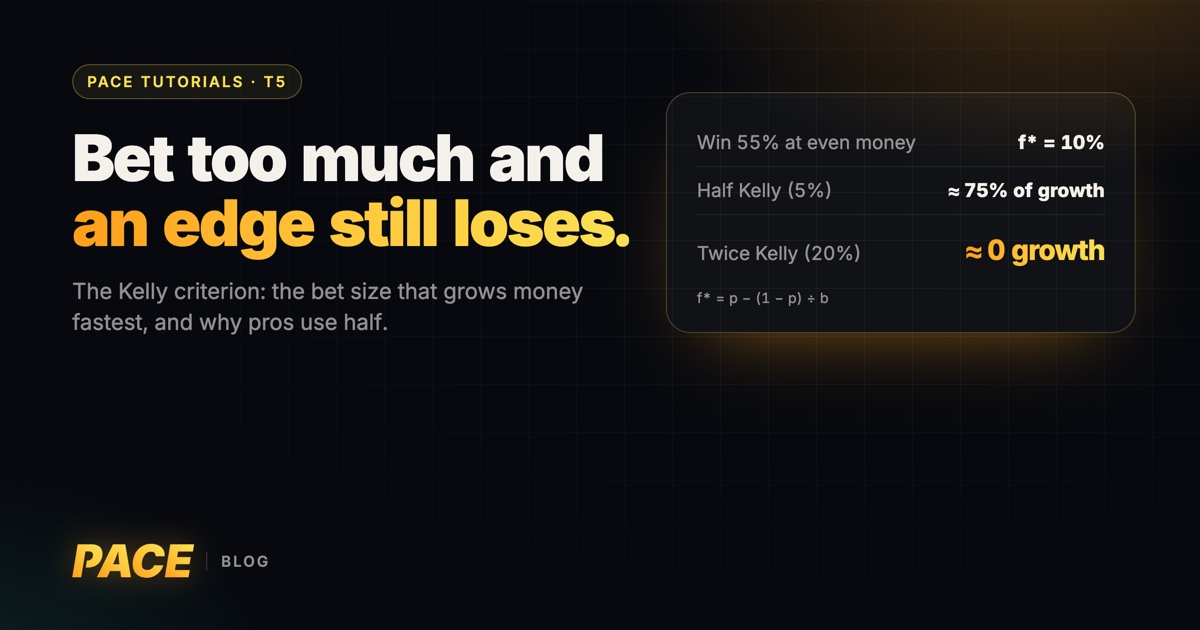
You have a real edge: a bet you win 55% of the time at even money. How much of your money should you put on each bet?
Most people's instinct is "as much as possible, I have an edge". That instinct goes broke. The answer comes from a 1956 paper by John Kelly, an engineer at Bell Labs, and it is one of the most important ideas in money management. It also applies to how you size positions.
Quick check. With a 55% win rate at even money, which bet size grows your money fastest: 5%, 10%, 20% or 50% of your bankroll per bet?
And what happens at 20%? The answer surprises almost everyone.
The formula
For a simple bet that pays b times your stake when you win and loses your stake when you lose:
f* = p − (1 − p) ÷ b
- f* = the fraction of your capital to stake
- p = the probability of winning
- b = the net amount you win per unit staked, divided by the amount you lose per unit staked
With p = 0.55 and b = 1: f* = 0.55 − 0.45 = 0.10, so 10% of your capital per bet.
Why more is worse
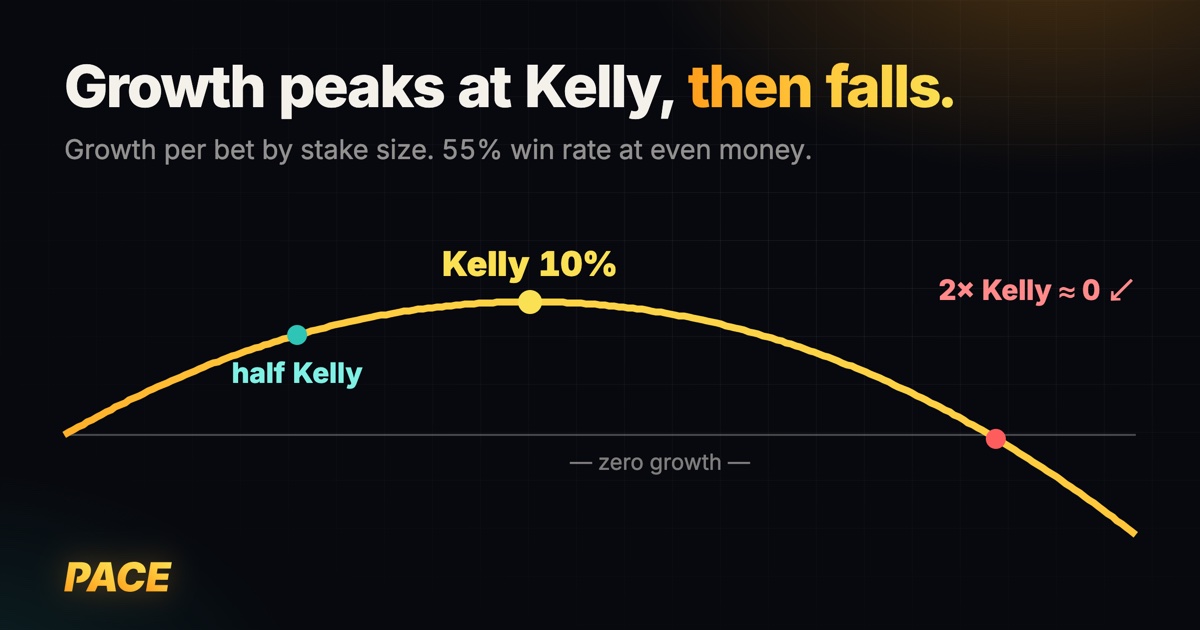
Kelly maximises the long-run growth rate of your capital. Here is the expected growth per bet at different sizes for our 55% coin:
| Fraction staked | Growth per bet |
|---|---|
| 5% (half Kelly) | +0.38% |
| 10% (full Kelly) | +0.50% |
| 15% | +0.37% |
| 20% (2× Kelly) | ≈ 0% (slightly negative) |
| 25% | −0.67% |
Look at the 20% row. With a genuine edge, betting twice Kelly gives you zero growth, and anything more makes you poorer over time, even though every single bet has a positive expected value. Overbetting turns a winning edge into a losing strategy.
Why professionals use half Kelly
Full Kelly is a rough ride. In Edward Thorp's analysis of idealised Kelly betting, the chance that a full-Kelly bettor's capital at some point falls to half is about 50%.
Half Kelly gives about 75% of the growth with roughly half the volatility, and the chance of ever halving drops to about 12.5%. Leonard MacLean, Thorp and William Ziemba describe this trade-off as one of Kelly's "good and bad properties". And because you never know your true edge exactly, betting a fraction protects you if you overestimated it.
Three mistakes with Kelly
- "Full Kelly = 100%." No. Full Kelly means staking the full calculated fraction f*, which here is 10%, not all your capital. Fractional Kelly is λ × f*, for example half of it.
- Using the win/loss count for b. In the formula, b is the ratio of the amounts won and lost per unit staked, not the number of winning trades divided by losing ones.
- Trusting a backtest's p blindly. Kelly is extremely sensitive to the inputs. If your real p is 52%, not 55%, the right stake falls from 10% to 4%. An overestimated edge pushes you straight into the overbetting zone.
A useful check: in this simple model, f* has the same sign as your expected profit per bet, p × b − (1 − p). If Kelly says "bet nothing" while your backtest says "profitable", the backtest and the inputs are not describing the same thing.
The principle
Size by edge and by uncertainty, never by excitement. Without a measurable edge, Kelly says zero. With one, use a fraction of Kelly, because your estimate of the edge is always too optimistic.
Your checklist
- Write down your win rate p and your payoff ratio b from real results, not hopes.
- Calculate f*, then halve it.
- Recalculate with p five points lower. If the answer changes a lot, size smaller.
- Never size a position larger than you could lose without changing your life.
Answer to the quick check
10% grows fastest. At 20% the growth is roughly zero, and at 50% you would almost surely lose most of your money over time.
Sources
- Kelly, J. L. (1956). A New Interpretation of Information Rate. Bell System Technical Journal, 35(4), 917–926. Link
- Thorp, E. O. (2008). The Kelly Criterion in Blackjack, Sports Betting and the Stock Market. In Handbook of Asset and Liability Management, 385–428. Link
- MacLean, L. C., Thorp, E. O. & Ziemba, W. T. (2011). Good and Bad Properties of the Kelly Criterion. In The Kelly Capital Growth Investment Criterion, World Scientific, 563–572. Link
Educational content, not financial or gambling advice. The 55% coin is an illustration. Real-world edges are uncertain and investing carries the risk of loss.